


Take Care


Take Care opens on the afternoon of Thursday 12 December 2019 as Rob and Lindsey Burrow learn that their lives have changed forever. “We still feel young, at thirty-seven, and Rob has been my one and only love since we were fifteen,” Lindsey says as if she is lost in that moment before their world imploded at a hospital in Leeds. “A month ago we moved our gorgeous family into our dream home. Life seems almost perfect.”
The diagnosis of motor neurone disease rips through their lives like a bomb blast.
When they are alone again Rob's immediate reaction is to try and comfort Lindsey. He says, in his typical way, “Thank God it's me - and not you or the children.”
Rob doesn't say: “Why me?”
There is no self-pity and, as Lindsey is far more traumatised, he tries to lift her. “It will be okay, Lindsey,” he says. “We'll get through this.”
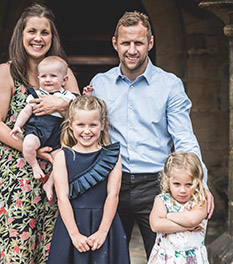
But Lindsey knows that everything will not be okay. She has a sudden premonition of her incredible husband withered inside his immobile body. Lindsey feels frightened for Rob. She sees herself spooning mashed-up food into mouth and struggling to wash him in the shower. She imagines lifting him up in her arms as she carries the dead weight of his body to bed. She hears herself chatting away to Rob even though, eventually, he will be as mute as she is so soon after the diagnosis.
As they look helplessly at each other she feels a new surge of love. Her heart is not broken after all. It's still pumping, for Rob, and Lindsey knows she is ready to care for him, tenderly and constantly, for however long they have left.
After they share the shattering news with their family the book opens a window into Lindsey's past. We learn how her resilience is rooted in the Yorkshire mining background of her parents and grandparents. Her dad was one of the 142,000 miners who went on strike against Margaret Thatcher and the National Coal Board in 1984 as they tried to stop the pit closures which decimated towns such as Castleford where Lindsey had been born two years earlier. She was obviously too young to understand how devastating those years were for her parents, and the entire community, but they were so destitute during the strike that they relied on soup kitchens and food hampers for so many of their meals.
The old family story of how her parents reacted to the hardship and deprivation resonates all these decades later. Seeing the long, snaking lines of people in front of them, they would laugh and make it a surprise treat. “Oh, look Lindsey,” her mum would exclaim, “the café's really busy today!”
“Yeah,” her dad would say with a chuckle, “they must have something really tasty for our tea.”
They turned the bitter conflict into a game. The 'café' was actually a soup kitchen at the Methodist church hall on Carlton Street in Castleford.
Her grandfather's mining experience prefigured the fate of Rob. In 1969, while working at the Allerton Bywater Colliery, just two miles north of Castleford, Jimmy Bray was involved in a terrifying accident. He and three other miners were working in the pit when a shaft collapsed. His close friend was struck on the head by a girder and fell down dead on Jimmy. A large portion of the pit then caved in on them, burying the men underground.
Jimmy was protected from most of the falling rubble by the body of the friend he had just lost. But he was still buried beneath a deep mound of the pit. It was frightening and suffocating because Jimmy and the two other survivors were trapped inside a black tomb of coal. The feeling of paralysis was especially acute for Jimmy because he was pinned down by a corpse.
Emergency excavation work began soon after the accident. But the men were buried so deep that hopes of a rescue faded with each passing hour. Twelve hours slipped away before Jimmy was finally rescued. He had been through such trauma and he only found the determination to go on because, while buried alive, he visualised the future in his dazed mind.
He imagined the weddings of Sue and Sharon [Lindsey's mum] and played them out, scene by scene. The pictures he dreamed up in his head, while struggling for breath, helped keep him alive and he swore that, if he ever made it out of the pit, he would savour every hour of every day he had left as if it was his last.
Having had Rob shackled by MND, Lindsey tries to treasure life even more. She is given strength and hope by the remarkable positivity that Rob always shows even when he is buried inside his body more distressingly than Grandad Jimmy had been trapped beneath his dead friend and a vast mountain of coal.
Take Care moves back and forth between the present and the past. We revisit Rob and Lindsey's teenage years, their brief separation when they are seventeen, and their falling in love as young adults. The book captures the glory of Rob's prime years in rugby league, as the Leeds Rhinos win one grand final after another, while charting their very ordinary and homely lives together.
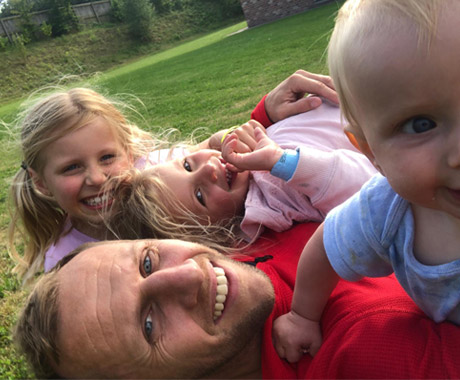
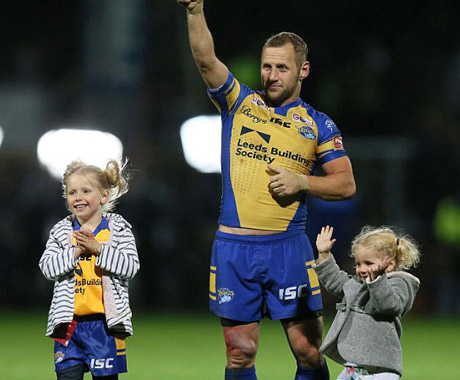
These scenes, which lead to their marriage and their lives as new parents, contrast with the brutality of MND - and the compassion with which Lindsey cares for Rob.
The last four chapters are mostly written in the present tense, and they unfold in chronological order, as we are with Rob and Lindsey, and their children, when he dies. We are also at his strangely uplifting funeral which becomes a celebration of his life. These might seem hard chapters to read but, if they reflect the mood of our writing, they are filled with light, hope and, above all else, love.
On Sunday 2 June 2024, at Pinderfields Hospital in Wakefield, Rob died peacefully, surrounded by his family. These passages are written in Lindsey's voice:
I lean over to kiss Rob goodbye and then I turn to the children and open my arms. They fill me up as I hold them close.
When they look at their dad they all cry but they also do something beautiful. They open Rob's hands. His fingers are still painted red and yellow and green and then, telling them how much they love him, they take turns to pour the little knitted hearts from the night before onto his upturned palms. When they close his hands around their hearts it feels complete.
We will always carry Rob, their dad, with us forever.
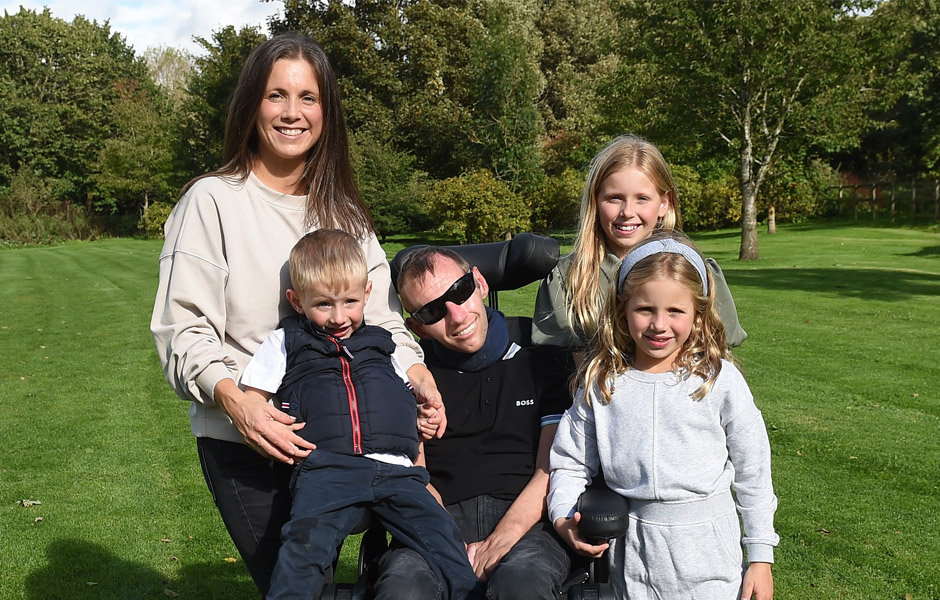
There is grief too, especially after the outpouring of love for Rob and support for Lindsey that sweeps across the nation in the wake of his death. We do not avoid the pain but, even here, there are cracks of light in the dark. Writing in Lindsey's voice, in the penultimate chapter, we have these lines:
The days passed and I felt Rob's absence acutely. I kept waiting for his machine to kick into gear and that next voice-note to arrive. I yearned to hear Rob ask me for a Red Bull or to change the channel on television. I also longed for that feeling of being run off my feet as, beyond looking after the children, so much of my time had been devoted to caring for Rob.
I missed him and found the silence hard to bear. Even though we had not had a proper conversation for a long time I also missed the sound of my own voice talking to him. He was no longer there to hear me chatting away or voicing out loud any worries I had. There was just a hushed emptiness to the house when the kids were at school. I felt very alone.
Towards the end of that first week without Rob I spent an hour clearing stuff we had accumulated in the garage. As I walked back into the front room, I saw this little white feather right next to Rob's chair.
I stared at it. I knew it had not been there when I went into the garage. “Rob,” I said softly in my head, “is that you?”
Of course anyone else would think I was just being silly because feathers float down all the time without us really noticing them. But this felt real. It felt like a sign from Rob.
A few weeks before, after all, I had asked Rob to try and send me a sign, if he could, to let us know that he was still with us. It was one of our poignant little jokes - just like Rob saying he hoped that he could become a ghost who would watch over us.
I took a photograph of the feather on my phone and then, carefully, I picked it up. My fingers curled around the feather to keep it safe.
Later, I googled the apparent meaning of a fallen white feather. I am not a particularly religious or spiritual person but I found comfort in the online articles suggesting that it signified a link to a place existing outside our physical world. I lingered over a few lines which claimed that finding a fallen feather offered 'a connection to spiritual realms. Coming from birds, feathers symbolise freedom, both mental and physical, from the bounds of the earth.'
Logically, I know this is meaningless. But I want to believe it's true. I want to believe that my tiny feather is a message from Rob.
I feel Rob is still watching over us and, more than ever, I want to make him proud.
“A tender, powerful and life-affirming book by one of the bravest people I know. The story of Lindsey, Rob and their amazing children will make you want to live every day to the fullest.” Kevin Sinfield
“Anyone who reads this book will find inspiration, comfort and maybe even hope when it seems that all is lost. Above everything else, this is a love story.” Sally Nugent
“Deeply moving and inspiring” Clare Balding
“Remarkable...” The Times
